84. Largest Rectangle in Histogram Hard

Given n non-negative integers representing the histogram’s bar height where the width of each bar is 1, find the area of largest rectangle in the histogram.

img
Above is a histogram where width of each bar is 1, given height = [2,1,5,6,2,3].

img
The largest rectangle is shown in the shaded area, which has area = 10 unit.

Example:

1
2
Input: [2,1,5,6,2,3]
Output: 10

思路:

思路一:暴力破解

  • 先用 HashSet 存储数组中不重复的值,主要是用来加速的,不用也可以,像在本题里面就可以少算一次 2
  • 然后遍历这个 set,再在 set 中进行数组遍历,找到连续比当前值大于或等于的数组值,并找到最大的宽度,像在上面的🌰中,当值为 1 时,遍历一遍后,最大的的宽度为 6

代码:

1
2
3
4
5
6
7
8
9
10
11
12
13
14
15
16
17
18
19
20
21
22
public int largestRectangleArea(int[] heights) {
Set<Integer> set = new HashSet<>();
for (int height : heights) {
set.add(height);
}
int res = 0;
for (int height : set) {
int width = 0;
int max = 1;
for (int value : heights) {
if (value >= height) {
width++;
} else {
max = Math.max(max, width);
width = 0;
}
}
max = Math.max(max, width);
res = Math.max(res, max * (height));
}
return res;
}

时间复杂度:O(n^2)

空间复杂度:O(n)

思路二:

这个思路有点和 42题 有点像,可以看下面的🌰:

image-20201104211954756

  • 在思路一中,是将每一个不重复的数组元素和整个数组进行对比,求出最大面积
  • 在 该解法中,仍然是求每个柱子所占的最大面积,最后取最大的即可
  • 红色是当前柱子,分别找到离该柱子左边最近比该柱子低的柱子 leftMin 和右边最近低于该柱子的柱子 rightMin
  • 此时的面积可以计算为:heights[cur] * ( rightMin - leftMin -1)

那么如何求出每一个柱子的 leftMin ,下面的代码是时间复杂度为 O(n)

1
2
3
4
5
6
7
8
9
int[] leftMin = new int[heights.length];
leftMin[0] = -1;
for (int i = 1; i < heights.length; i++) {
int temp = i - 1;
while (temp >= 0 && heights[i] <= heights[temp]) {
temp--;
}
leftMin[i] = temp;
}

当然上面的代码是可以降低时间复杂度的,可以看下面这个🌰:

image-20201105202816731
  • 如果我们要求 curleftMin ,可以放弃一部分比较,具体是哪一部分呢?
  • 如果当前 cur 高度小于 cur - 1 ,那么 leftMin[i - 1] + 1cur - 1 之间所有柱子的高度都是大于 cur 的,因为 leftMin[i - 1] 是第一个比 cur - 1 低的
1
2
3
4
5
6
7
8
9
int[] leftMin = new int[heights.length];
leftMin[0] = -1;
for (int i = 1; i < heights.length; i++) {
int temp = i - 1;
while (temp >= 0 && heights[temp] >= heights[i]) {
temp = leftMin[temp];
}
leftMin[i] = temp;
}

代码:

1
2
3
4
5
6
7
8
9
10
11
12
13
14
15
16
17
18
19
20
21
22
23
24
25
26
27
28
29
30
31
public int largestRectangleArea(int[] heights) {
if (heights.length == 0) return 0;

int[] leftMin = new int[heights.length];
leftMin[0] = -1;
for (int i = 1; i < heights.length; i++) {
int temp = i - 1;
while (temp >= 0 && heights[temp] >= heights[i]) {
temp = leftMin[temp];
}
leftMin[i] = temp;
}

int[] rightMin = new int[heights.length];
rightMin[heights.length - 1] = heights.length;
for (int i = heights.length - 2; i >= 0; i--) {
int temp = i + 1;
while (temp <= heights.length -1 && heights[temp] >= heights[i]) {
temp = rightMin[temp];
}
rightMin[i] = temp;
}

int max = 0;
for (int i = 0; i < heights.length; i++) {
int temp = (rightMin[i] - leftMin[i] - 1) * heights[i];
max = Math.max(max, temp);
}

return max;
}

思路三:栈

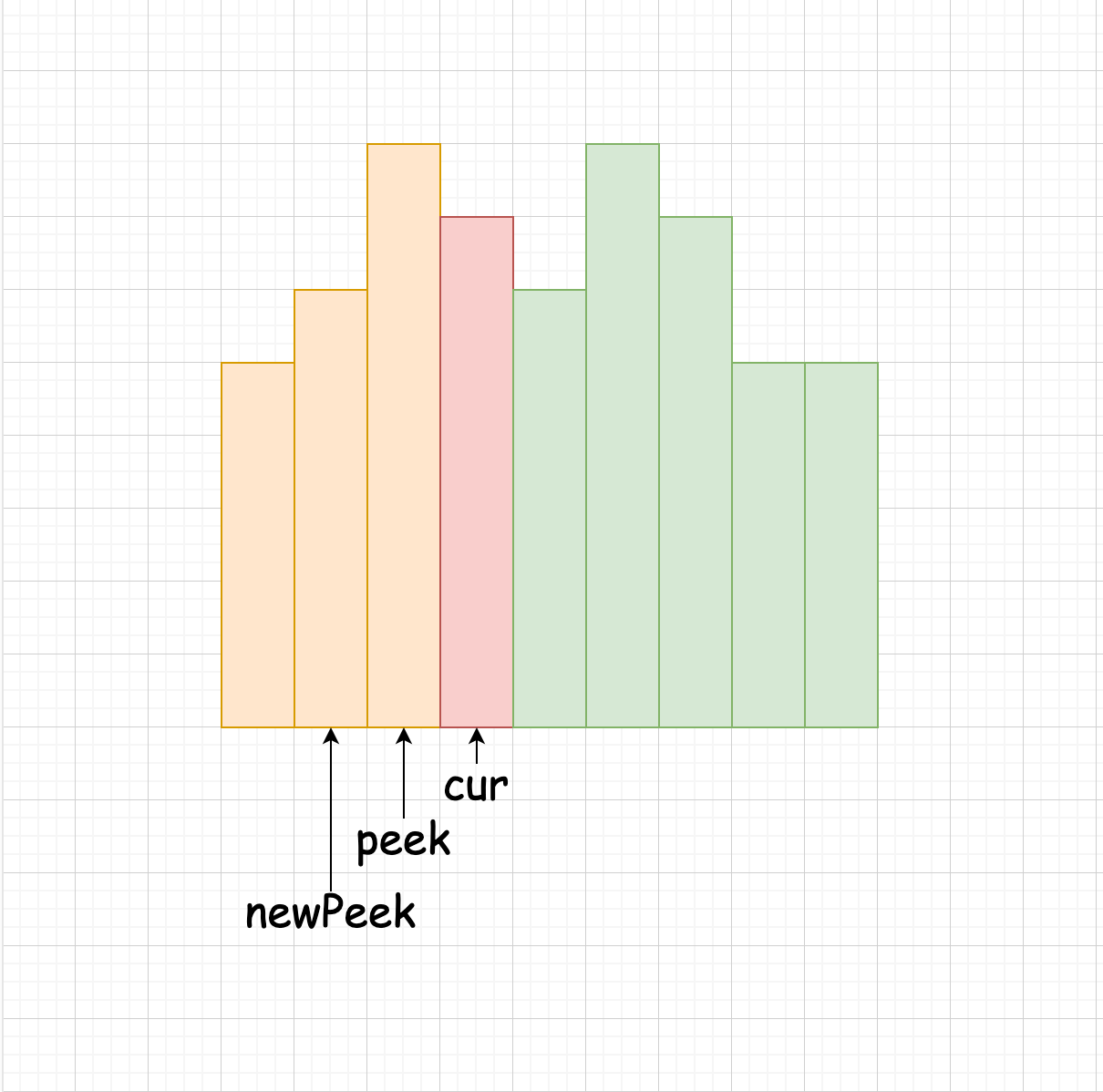
  • 当遍历到 cur 时,出现 height[cur] < height[peek] 时,那么 leftMin 一定是 newPeekrightMin 就是 cur ,此时面积最大值就是 (cur - leftMin - 1) * height[peek]

image-20201105212528335

代码:

1
2
3
4
5
6
7
8
9
10
11
12
13
14
15
16
17
18
19
20
21
22
23
24
25
26
27
28
29
30
31
32
public int largestRectangleArea(int[] heights) {
int max = 0;
Stack<Integer> stack = new Stack<>();
int i = 0;
while (i < heights.length) {
if (stack.isEmpty()) {
stack.push(i);
i++;
}
else {
int peek = stack.peek();
if (heights[i] >= heights[peek]) {
stack.push(i);
i++;
}
else {
int height = heights[stack.pop()];
int leftMin = stack.isEmpty() ? -1 : stack.peek();
int area = (i - leftMin - 1) * height;
max = Math.max(area, max);
}
}
}

while (!stack.isEmpty()) {
int height = heights[stack.pop()];
int leftMin = stack.isEmpty() ? -1 : stack.peek();
int area = (heights.length - leftMin - 1) * height;
max = Math.max(area, max);
}
return max;
}

评论